Long term care in the United States is a hot mess. The only good thing about it follows: it offers opportunity for people with the right heart to do God’s work. We all know intuitively, that the weak and vulnerable are next to God’s heart. The LTC mission field is everywhere, and with an endless list of urgent need. About 50% of LTC residents suffer from dementia, and are one of the most vulnerable populations among us. However, there is a dearth of skills among LTC staff in caring for dementia residents.
Long term care in the U.S. is an epic failure. According to the American Healthcare Association and the National Center for Assisted Living, only 37% of Americans believe that LTC facilities deliver quality care. The flip-side statistic tells us that 70% of families take care of their loved ones at home regardless of the strain on family dynamics. Nursing homes are closing at higher rates than new ones are opening, primarily due to staffing issues.
So, if LTC offers such a grand opportunity to do good, why all the failure? This is not hard to assess. 33% of new nurses leave the profession within 2 years, and the primary reasons cited by the AMA and OJIN are weak leadership, weak mentoring by experienced nurses, burnout, and workplace toxicity. These are all leadership issues. And worse yet, nurses that are burned out leave bedside to become LTC DONs and Executive directors of LTC facilities. Because they hate being bedside, they will capitulate to anything or anyone who will keep them off the floor.
However, all of the aforementioned is set against the following fact according to my own experience: the majority of new students who enter CNA programs are exceptional young people. Yes, some cohorts are mostly petulant immature narcissists, but they are usually 1 for every 4 cohorts. In the good cohorts, you will have a few toxic individuals who have no business being in healthcare. As nurses, we know that every facility has a small percentage of exceptional aides, and of course, there is an overall CNA shortage in healthcare.
But why? Where are all of these quality young people going? Well, the LTC industry is chewing them up and spitting them out, and only those who were looking for a job and found healthcare remain. LTC leadership supplies no vision for quality young people, and no clear path to self-actualization. And to no degree is the realization of what the nurse aide discipline brings to healthcare brought to bear by leadership.
We know that the key to reviving LTC is the nurse aide discipline. We know this because no facility could survive or operate for one day without nurse aides. We know this because the primary priority framework for care is Maslow’s Hierarchy of Needs, and those priorities of physiological need (ADLs), safety, love, dignity, and self-actualization are all in the venue of the nurse aide. Nurse aides are the foundation of care, and they are the sensory extension of every nurse―nurse effectiveness is determined by a facility’s aide culture…period…end of discussion.
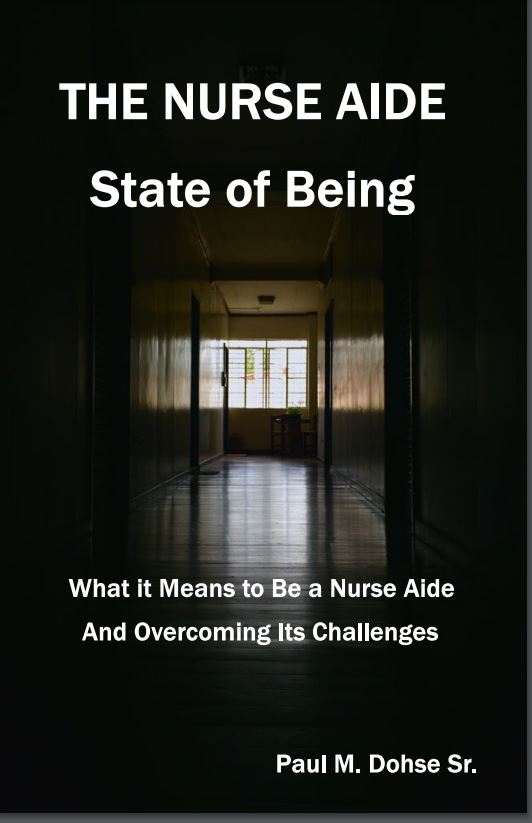
With that being said, few if any administrators are going to orchestrate an elite aide culture, this must be done at the education level. Where are all the elite nurse aides going? They are being driven out by the toxic 10% while LTC administrators watch and do nothing. Therefore, CNA educators must not only teach skills, but supply CNA’s with tools to be survivors and self-motivators. Educators must supply future nurse aides with a full vision of what a nurse aide is, and the right logic/thinking that will lead to long-term survival. The Nurse Aide State of Being (TANC publishing, 2025) is a baby step in that direction.
Recently, I led a clinical with 10 CNA students. This was a cohort of exceptional individuals. We were on break, and as the students listened to me bemoan poor leadership in LTC, one of the students said, “Well, maybe we should all become DON’s or Executive Directors.” Full stop. I replied, “I would give my very life to see that happen.” And there you have it. A common belief in LTC among nurses is, “The aides run the facility.” Indeed, in many facilities, if not most, that is the case. This is because there is a nurse aide shortage, and again, no facility can function without them. And of course, nurse aides know this and use it to force their will on a facility. Few nurses will stand up to toxic aides. Time and time again, toxic nurse aides display outrageous behavior and an overt disrespect towards nurses without consequences.
Nevertheless, it’s not all bad that nurse aides potentially run a facility; the question is, “What kind of nurse aides?” Fact is, if a facility is occupied by an elite group of nurse aides, the facility will function well with sufficient staffing despite itself. I believe this regardless of the following: the ability of nursing leadership to fail can never be underestimated.
To the best of my knowledge, God has been sending quality individuals to CNA schools, in droves, since 2019. I was a CNA at a facility where a high school would bring students for clinicals, and many were assigned to follow me around. As far back as that time (2019), I was amazed in regard to their quality as individuals. Today, as a CNA instructor, I can tell you God is still sending them.
But where are they? Again, because we are only teaching them skills, they are being chewed up and spit out by toxic aides and poor leadership. If we teach them how to survive, they will be the aides running facilities, not the toxic ones. This entails teaching them the full identity of what an aide is, and how the job can facilitate their own self-actualization.
And that is the key to horizontal practical happiness as a result of person-building. When others are not person-building, others who are, expose them for who they really are. When you see a shiny new skyscraper next to a dilapidated shack, the picture is immediately self-explanatory. This is why toxic aides will seek to tear down aides that are the real deal. We must go beyond teaching skills, we must teach them how to survive and grow in healthcare. This is yet another way to advocate for LTC residents.
If we don’t, our labors are in vain.
Paul M. Dohse, RN, CDP
 Therapeutic Soul Home
Leave a comment